 Store Location
 Track Order



Knotty Pine Versus Knotty Cedar Paneling
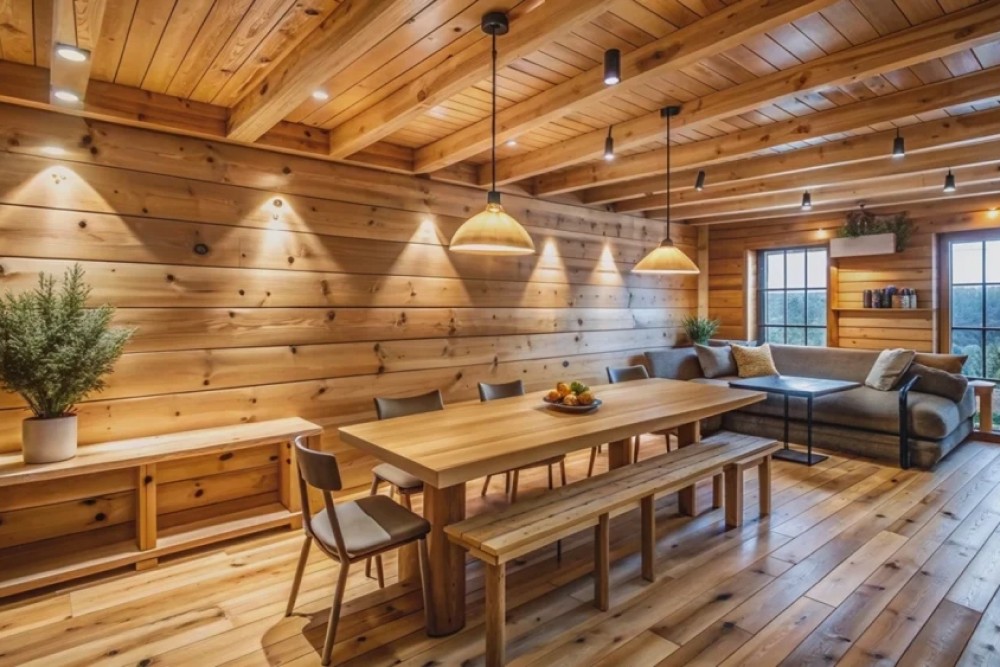
Knotty pine is an affordable, versatile, and classic choice for rustic interior walls, offering a warm look that takes stain well. Cedar is more expensive, durable, and aromatic, offering superior resistance to moisture, decay, and insects, making it an ideal choice for bathrooms or humid climates.
High-quality knotty pine and knotty cedar paneling are available for shipping right to your door. Knotty pine is available year-round, while knotty cedar is available when in season or in limited quantities. Let’s compare the two woods to help make the best choice for your purchase.
Description Of Knotty Pine Paneling
 Knotty pine paneling is a popular, rustic, and affordable interior wood, typically made from Norway or Red pine, featuring prominent, dark knots and varied grain patterns. It is commonly used for walls and ceilings to add warmth, often featuring tongue-and-groove, end-matched interlocking planks for easy installation. Its key features and characteristics include:
- Appearance: Offers a distinct, rustic, and cozy, cabin-like aesthetic with natural, unrefined, dark knots, mineral streaks, and color variations.
- Structure: Typically manufactured as tongue-and-groove (T&G) planks, often featuring a V-joint or beaded design.
- Installation: Modern panels are usually "end-matched," meaning they have tongue-and-groove joints on the ends as well as the sides, allowing boards to be installed between studs, which reduces waste and labor by 20–30%.
- Material: It is a softwood, often kiln-dried to prevent warping and shrinkage after installation.
- Versatility: Can be installed vertically, horizontally, diagonally on walls and ceilings, or in unique layouts.
- Finishing: Available in unfinished, clear coat only, and stained with clear coat.
- Cost: Most cost-effective domestic wood for paneling projects.
Description Of Knotty Cedar Paneling
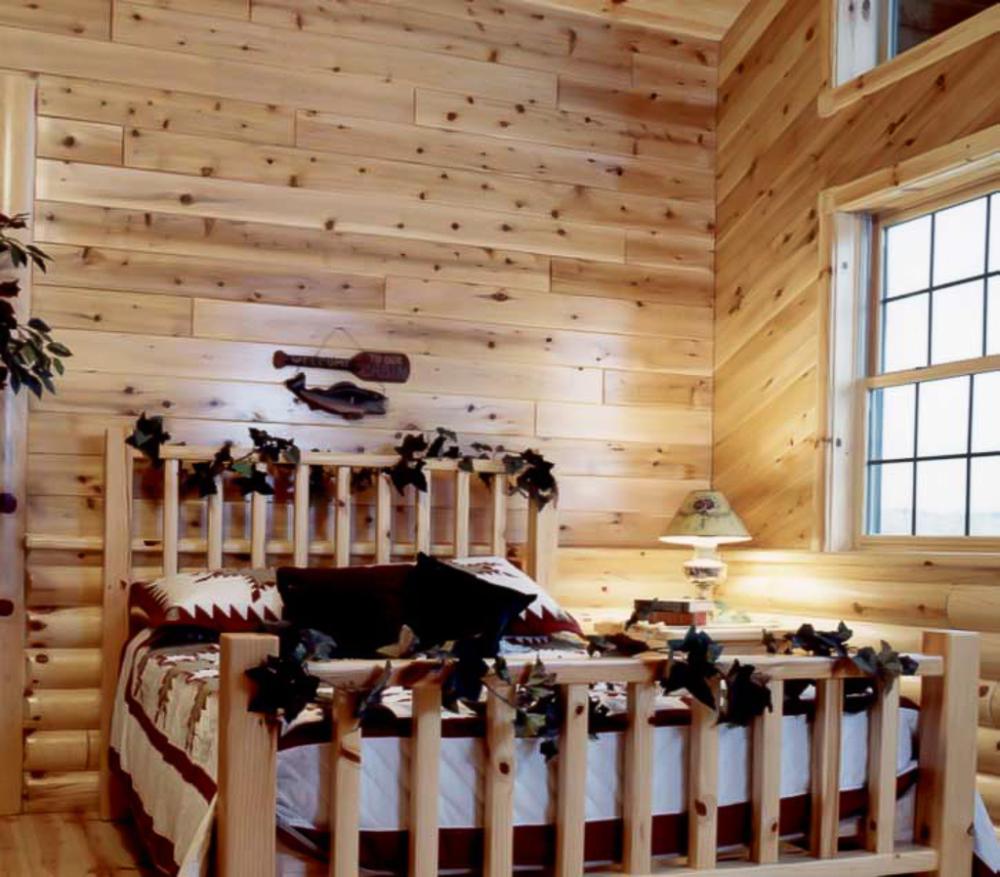 Knotty cedar paneling, primarily made from Northern white cedar, is a durable, somewhat aromatic, and rustic wood featuring prominent, tight, sound knots, and a rich, warm palette of reddish-brown to pinkish tones. It is commonly used for accent walls, ceilings, and paneling. It has excellent high R-value insulation qualities. Its key features include:
- Appearance: Features natural knots (often "select tight knots" or STK), which provide a rustic, character-filled, and unique look. Colors range from dark red to brownish-pink.
- Durability: Highly durable and naturally resistant to insects and decay, making it suitable for both interior and exterior use (like porches).
- Texture and Grain: Generally straight-grained with a soft, smooth texture.
- Installation: Commonly found in tongue and groove (T&G), shiplap, or channel patterns for straightforward, interlocking, and hidden-fastener installation.
- Finishing: Can be supplied raw, kiln-dried, or pre-finished, sometimes with UV-cured coatings.
- Cost: Generally more budget-friendly than clear (knot-free) cedar grades, but costs more than knotty pine.
“High-quality knotty pine and knotty cedar paneling are available for shipping right to your door.”
Direct Comparison Of The Two Woods
A direct comparison is helpful when deciding between knotty pine and cedar woods. This comparison is between Norway (red) pine and Northern white cedar.
| Knotty Pine Pros | Knotty Cedar Pros |
| More affordable | More moisture and insect resistant |
| Stable and durable | Stable and highly durable |
| Readily available | Typically more colorful |
| Easy to cut, shape, finish | Easy to cut, shape, finish |
| Lightweight and sustainable | Lightweight and high insulation value |
| Trees grow on tree farms | Ability to remain splinter free |
| Knotty Pine Cons | Knotty Cedar Cons |
| Somewhat softer wood | More expensive than pine |
| Typically less colorful | Can be more brittle wood |
| May absorb stains unevenly | Availability depends on current supply |
| Low sustainable wood | |
| Softwood |
Tongue And Groove Paneling Provides Best Results
 The best results for your pine or cedar projects are obtained by using tongue and groove (T&G) boards with the end-matching design. This configuration is fast and easy to install and provides a flat, even surface that does not cup. There is virtually no waste because the end piece from each row can be used to start the next row. The design allows two pieces to end-butt on wall framing and anywhere in between them, which still provides a strong, tight-fitting joint.
Installing T&G, end-matching paneling saves a lot of time measuring, sawing, and nailing it up. When you order the correct amount of paneling product, very little, if any, ends up in a landfill. The leftover pieces can be used for other projects because of its beauty, unlike leftover pieces of drywall used on walls and ceilings. By the way, these paneling products are also excellent for ceilings, wainscoting, and accent walls. If you are looking for wood flooring, try knotty pine because it has the same T&G, end-matching features. Don’t forget the trims and baseboards.
High-Quality Paneling Is Available Online
You can save time and effort by shopping online for high-quality, reasonably-priced knotty pine and knotty cedar paneling with The Log Home Shoppe. Our paneling is properly kiln-dried to the correct moisture content for stability, staining, and ready-to-install applications. The planks are available in the following sizes and finishes for your convenience:
Knotty Pine Paneling Features
4", 5", 6", 8" widths in unfinished condition
4", 5", 6", 8" widths pre-finished with clear coat finish
6” width with stain and clear coat finish
4", 5", 6", 8" widths blue paneling with clear coat finish
Sold in random lengths up to 96”
All pieces are ¾” thick
Sold in 220 sq. ft. packages
Knotty Cedar Paneling Features
4", 5", 6", widths in unfinished condition
6” width pre-finished with clear coat finish
Sold in random lengths up to 96”
All pieces are ¾” thick
In summary, knotty pine and knotty cedar paneling are gorgeous wood products to complete your interior walls and ceilings. Knotty pine is the most economical, while knotty cedar is more moisture-resistant. Good luck on your panel projects!


