 Store Location
 Track Order



Window Versus Portable Air Conditions For A Log Cabin

When central air conditioning is not an option for your log cabin, consider using window units or portables AC units. Window air conditioners for log cabins are generally more effective and energy-efficient for cooling than portable units because they vent hot air directly outside. Portable units are easier to install and move, but they are often louder, take up floor space, and can require manual draining. Portable ACs lose efficiency by reheating the room via their exhaust hoses.
Log Cabin Air Conditioning Comparisons
Each type of air conditioner has its pros and cons to weigh in making a decision. Study the details in this chart related to installation, portability, and use to help make a decision:
| Features | Window Units | Portable Units |
|---|---|---|
| Cooling Performance | More effective: Can lower room temperature 10° in as little as 15 minutes. | Less effective: Takes longer to cool room and may not reach full temperature. |
| Energy Efficiency | More efficient: Uses less electricity to cool. | Less efficient: Uses more electricity to cool. |
| Installation | More difficult: Heavier unit requires securing to window. |
Less difficult: Can be used quickly with a window unit. |
| Space | Provides more room space. | Provides less room space. |
| Portability | Can be moved to another window-requires work. | Easy to roll to another room. |
| Noise Level | Quieter because the compressor is outside rooms. | Louder because the compressor is inside rooms. |
| Maintenance | Requires filter cleaning but no water draining. | Requires filter cleaning and may need water draining. |
Window Air Conditioners
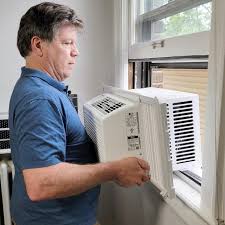 Log cabin window air conditioners include simple, traditional units and smart models that use AI to optimize cooling based on sensors, usage patterns, and environmental conditions. Traditional AC units are simple and easy to understand and operate. They cost less than units that use artificial intelligence features but are not as efficient.
"Smart" units can automatically adjust temperature and fan speed for efficiency, learn user preferences, and even include features, such as self-cleaning and occupancy detection to save energy and improve air quality. The choice of traditional or smart units depends on your needs, usage, and budget. Here are key features to look for in AI units:
- Adaptive and predictive cooling: AI algorithms analyze real-time data from sensors (like temperature, humidity, and occupancy) to dynamically adjust settings for optimal comfort and energy savings. Some units learn your preferences and automatically create personalized cooling routines.
- Smart modes: Many AI-enabled ACs have an "Auto" or "Smart" mode that intelligently switches between cooling and fan based on the room's needs.
“Each type of air conditioner has its pros and cons to weigh in making a decision.”
- Occupancy sensing: Some units can use sensors to detect if a room is empty and automatically adjust the temperature or turn off to prevent energy waste.
- Self-cleaning: Advanced models feature AI-powered self-cleaning functions that automatically clean the unit's filters, improving air quality and extending the ACs life.
- Connectivity and control: These units can typically be controlled via a smartphone app, voice assistants like Alexa or Google Assistant, or a remote, offering more convenient control from anywhere.
- Air quality enhancement: Some AI-powered models go beyond cooling to include features that monitor and improve air quality, such as ionizers that can reduce bacteria and dust.
Portable Air Conditioners
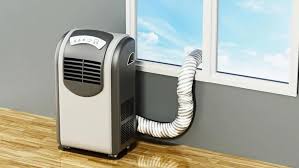 The three most important factors when shopping for a portable AC are their cooling capacity, portability, and power sources. Get one powerful enough to cool your space while being portable enough to roll or carry, and be sure its power source will last you all day and night. They are great choices when central air and window units are not the answer.
Portable ACs are relatively affordable, and they can be easily moved from room to room since they are not permanently or semi-permanently installed. They are ideal for cabins, condos, tiny homes, or apartments. Another advantage is you can take them with you for campers, RVs, trailers, or mobile homes. You can get cool in many places with an easy and fast installation.
Recommended Sizes For Rooms
These are the typical suggested sizes for different size rooms for window and portable units:
100–250 sq. ft.: 5,000–6,000 BTUs
250–350 sq. ft.: 8,000 BTUs
350–450 sq. ft.: 10,000 BTUs
450–550 sq. ft.: 12,000 BTUs
Consider other factors: Adjust your choice for factors, such as amount of sun exposure, ceiling height, and the number of people regularly in the room.
High sun exposure: Increase BTU by 10%.
High ceilings: Increase BTU by 10%.
More than two people: Add 600 BTUs per additional person.
Kitchen: Add 4,000 BTUs
There are many brands and models of window and portable air conditioners on the market. Choose one that meets your log cabin’s needs, usage, budget, and is the right size for rooms. Both types work just as well in log siding or full log cabins as they do in conventional homes.


